Deploying capital into Dubai real estate requires a rigorous, strategy-first investment framework. There is no single “best” community in Dubai for every investor. The optimal geographic allocation depends strictly on your capital basis, targeted investment horizon, risk tolerance, leverage profile, and investment mandate—whether maximizing net recurring cash-on-cash yield, seeking aggressive capital appreciation, or preserving multi-generational wealth in prime trophy assets.
An investor pursuing high rental yield from affordable apartments prioritizes low entry price per square foot, low service charges, and high tenant turnover liquidity. In contrast, an institutional investor or family office acquiring luxury villas or penthouses focuses on physical scarcity, barriers to entry, UHNW end-user demand, and long-term capital preservation.
This guide provides an empirical analysis of eight leading Dubai communities across core investment metrics: gross yields, net operating income (NOI), tenant demographics, and liquidity profiles.
1. Jumeirah Village Circle (JVC) — High Cash-on-Cash Rental Yields
Investment Mandate: Cash-flow maximization through affordable 1- and 2-bedroom rental apartments and mid-tier townhouses.
Developed by Nakheel, JVC is a dense, centrally located residential community situated between Al Khail Road (E44) and Sheikh Mohammed Bin Zayed Road (E311). It is consistently among Dubai’s highest-volume transaction communities.
- Target Tenant Demographic: Young expatriate professionals, mid-tier corporate executives, and couples seeking accessible rents within 20 minutes of major business hubs.
- Return Profile: Gross rental yields range between 7.5% and 9.0%; net operating yields typically normalize at 6.2% to 7.4% after Mollak service fees.
- Primary Risks: High supply pipeline and substantial building-to-building quality variances. Rigorous due diligence on developer MEP track records and building management is critical.
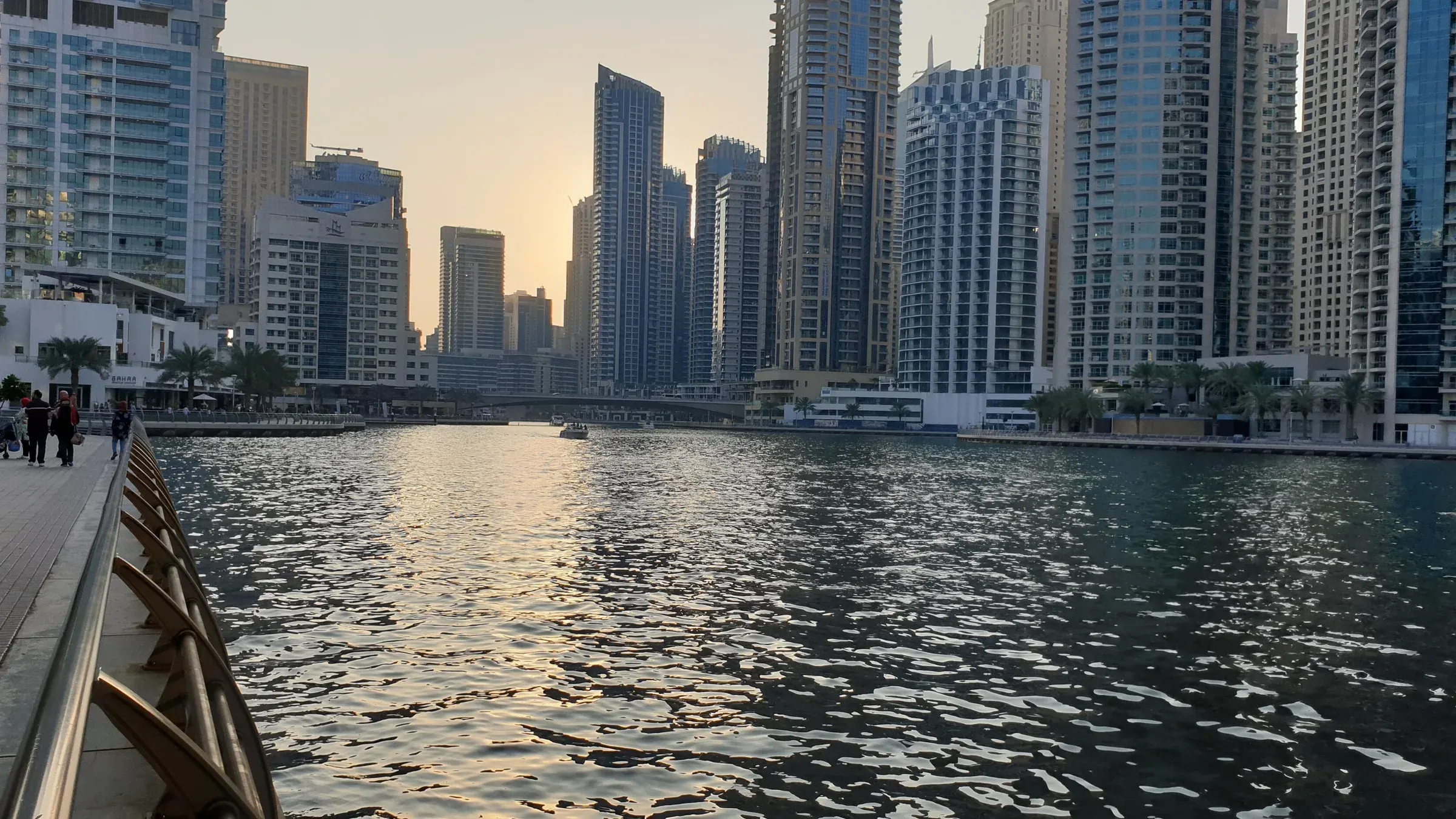
2. Dubai Marina — Urban Waterfront Demand & High Liquidity
Investment Mandate: Established urban waterfront apartments with resilient corporate tenant demand and secondary liquidity.
Dubai Marina provides investors with mature infrastructure, captive executive tenancy, and consistent secondary-market trading liquidity.
- Target Tenant Demographic: Expatriate corporate professionals, technology sector employees, and international second-home renters.
- Return Profile: Gross yields average 6.5% to 7.8%; net yields average 5.2% to 6.2%. Prime units also generate premium returns on the short-term holiday home market (DTCM licensed).
- Primary Risks: Wide divergence in building age and mechanical maintenance across towers. High Mollak service charges (AED 16 to AED 26/sq. ft.) in select older high-rises can compress net yields.
3. Business Bay — Central Urban Growth & Commercial Proximity
Investment Mandate: Mixed-use urban apartments capturing strong long-term rental demand from the DIFC and Downtown corporate corridors.
Bordering the Dubai Water Canal and Downtown Dubai, Business Bay is a dynamic mixed-use commercial and residential district with expanding branded hospitality towers.
- Target Tenant Demographic: Finance professionals, consultants, tech founders, and legal executives working in DIFC and Downtown.
- Return Profile: Gross yields range from 6.2% to 7.5%; net yields average 5.0% to 6.1%.
- Primary Risks: Heavy traffic congestion along Marasi Drive during peak hours and variations in construction quality among private sub-developers.
4. Dubai Creek Harbour — Waterfront Capital Appreciation & Growth
Investment Mandate: Long-term capital growth combined with stable rental yields in a master-planned Emaar waterfront ecosystem.
Positioned adjacent to Ras Al Khor Wildlife Sanctuary, Dubai Creek Harbour represents Emaar’s flagship modern waterfront expansion, featuring Creek Island and Creek Beach.
- Target Tenant Demographic: Upper-middle-income families, creative professionals, and expatriates seeking pedestrian open spaces and marina promenades.
- Return Profile: Gross rental yields average 6.0% to 7.2%; net yields average 4.8% to 5.8%. Excellent capital appreciation upside as metro links and retail infrastructure complete.
- Primary Risks: Phased multi-year development timelines; investors must distinguish between immediate cash-flowing ready towers and multi-year off-plan releases.
5. Dubai Hills Estate — Prime Mixed Residential Allocation
Investment Mandate: Institutional-grade capital preservation and balanced family tenant demand across apartments, townhouses, and villas.
Spanning 2,700 acres along Al Khail Road, Dubai Hills Estate combines championship golf, expansive parklands, top-tier schools, and Dubai Hills Mall.
- Target Tenant Demographic: Affluent families, multinational corporate directors, and expatriate executives.
- Return Profile: Apartments yield 6.2% to 7.4% gross; townhouses and family villas yield 4.8% to 6.0% gross with outstanding capital value resilience.
- Primary Risks: Premium acquisition valuations per square foot require long-term investment horizons (5+ years) to capture maximum capital gains.
6. Dubai South — Strategic Macro Infrastructure Play
Investment Mandate: High-upside macro investment anchored by the long-term expansion of Al Maktoum International Airport (DWC) and Expo City.
Dubai South is a 145-sq.-km master development positioning southern Dubai as the premier logistics, aviation, and residential corridor of the Dubai 2040 Urban Master Plan.
- Target Tenant Demographic: Aviation personnel, logistics specialists, engineers, and workforce professionals based at DWC and JAFZA.
- Return Profile: Gross rental yields range between 6.8% and 8.5% on modern apartments and 5.5% to 6.8% on Emaar South townhouses.
- Primary Risks: Infrastructure delivery timelines are multi-decade; investors must base cash-flow models on current operational demand rather than speculative future milestones.
7. Palm Jumeirah — Ultra-Prime Capital Preservation & Trophy Assets
Investment Mandate: Sovereign-grade capital preservation, global ultra-wealth positioning, and exclusive waterfront scarcity.
Palm Jumeirah is Dubai’s benchmark ultra-luxury coastal address, commanding the highest barrier to entry and lowest physical supply elasticity.
- Target Tenant Demographic: Ultra-high-net-worth individuals, international family offices, celebrity second-home owners, and executive corporate tenants.
- Return Profile: Prime beachfront villas yield 3.8% to 5.0% gross; luxury apartments yield 5.5% to 6.8% gross. Capital growth and liquidity for turnkey renovated mansions remain among the highest in global prime real estate.
- Primary Risks: High absolute ticket sizes (AED 20M to AED 150M+) and ongoing maintenance obligations for beachfront plots and private pools.
8. Tilal Al Ghaf — High-Demand Contemporary Villa Investments
Investment Mandate: Capitalizing on the structural undersupply of contemporary, resort-style family villas and townhouses in Dubai.
Majid Al Futtaim’s master community centered around Lagoon Al Ghaf provides modern luxury villas, townhouses, and international schooling.
- Target Tenant Demographic: High-earning international families seeking modern architecture, private swimming pools, and resort-grade amenities.
- Return Profile: Townhouses yield 5.8% to 6.8% gross; luxury lagoon villas yield 4.5% to 5.5% gross with robust capital appreciation.
- Primary Risks: Higher upfront acquisition costs compared to older suburban villa stock.
Investment Community Comparison Matrix
| Community | Core Typologies | Est. Gross Yield | Capital Growth | Primary Appeal |
|---|---|---|---|---|
| JVC | Apartments & Townhomes | 7.5% - 9.0% | Moderate | Max cash yield |
| Dubai Marina | Waterfront High-Rises | 6.5% - 7.8% | Moderate-High | Liquid leasing |
| Business Bay | Canal & City Towers | 6.2% - 7.5% | Strong | Downtown hub |
| Dubai Creek Harbour | Waterfront Towers | 6.0% - 7.2% | High | Master plan |
| Dubai Hills Estate | Villas, Townhomes, Apt | 5.2% - 7.0% | Very Strong | Blue-chip prime |
| Dubai South | Golf Villas & Apts | 6.5% - 8.2% | High Long-term | Airport growth |
| Palm Jumeirah | Mansions & Penthouses | 4.0% - 6.5% | Exceptional | Trophy wealth |
| Tilal Al Ghaf | Lagoon Villas & Homes | 5.0% - 6.5% | Strong | Modern luxury |
How to Formulate Your Investment Analysis
Step 1: Calculate Gross vs. Net Rental Yields
- Gross Rental Yield: $$\text{Gross Yield} = \left(\frac{\text{Annual Rent}}{\text{Purchase Price}}\right) \times 100$$
- Net Operating Income (NOI) Yield: $$\text{Net Yield} = \left(\frac{\text{Annual Rent} - (\text{Service Charges} + \text{Insurance} + \text{Management} + \text{Vacancy})}{\text{Total Capital Outlay (Purchase Price + 4% DLD + Fees)}}\right) \times 100$$
Step 2: Benchmark Registered DLD Transfer Data
Never base investment pro formas on asking portal prices. Access verified transaction records on the Dubai Land Department Real Estate Data portal to establish empirical transacted values.
Step 3: Factor in the Supply Pipeline
Review RERA project registration statistics to evaluate upcoming handovers within your micro-district over the next 12 to 36 months.
Step 4: Model Cash-on-Cash Return for Mortgaged Acquisitions
If utilizing bank financing, model your debt-service coverage ratio (DSCR). Ensure net rental revenue covers principal and interest payments with a minimum 1.25x coverage buffer against interest rate fluctuations.
Due-Diligence Checklist for Property Investors
- Define targeted hold horizon (short-term flip, 3-5 year yield hold, or 10+ year wealth preservation).
- Verify the developer’s registered escrow account and construction audit status for off-plan assets.
- Review audited Mollak service charges for the candidate building over the preceding 24 months.
- Calculate all upfront transaction costs: 4% DLD fee, AED 4,200 trustee fee, 2% broker fee (+ 5% VAT), and conveyancing fees.
- Inspect physical snagging reports covering MEP equipment, chiller efficiency, and water proofing.
- Verify tenancy status: ensure existing tenancy contracts comply with Law No. 26 of 2007 (and Law No. 33 of 2008) regarding 12-month eviction notice requirements.
- Confirm UAE Golden Visa eligibility (for purchases of AED 2,000,000 or greater).
Frequently Asked Questions
Which community in Dubai generates the highest rental yields?
Jumeirah Village Circle (JVC), Dubai South, and select apartment developments in Business Bay and Dubai Marina consistently deliver the highest gross rental yields, typically ranging between 7.0% and 9.0% gross on 1- and 2-bedroom configurations.
Which areas are best for luxury capital preservation?
Palm Jumeirah, Dubai Hills Estate, Emirates Hills, and Jumeirah Bay Island are Dubai’s premier blue-chip enclaves for capital preservation and high-barrier-to-entry trophy assets.
Is off-plan or ready property better for investment in Dubai?
Ready property provides immediate rental cash flow, full physical inspection certainty, and mortgage financing capabilities. Off-plan property allows staggered capital deployment via developer payment schedules and potential capital growth during construction, balanced against delivery delay risk.
How do Mollak service charges impact net returns?
Service charges are paid annually per square foot of owned area. In towers with excessive amenities or inefficient chiller systems, fees can exceed AED 25/sq. ft., reducing gross yields by 1.5% to 2.5%. Always review approved Mollak fee filings prior to signing contracts.
Can foreign investors buy property in all of these communities?
Yes. All eight communities analyzed—JVC, Dubai Marina, Business Bay, Dubai Creek Harbour, Dubai Hills Estate, Dubai South, Palm Jumeirah, and Tilal Al Ghaf—are officially designated 100% foreign freehold zones under Dubai Executive Regulation No. 3 of 2006.
Suggested Internal Reading
- Best Waterfront Communities in Dubai
- Best Communities for Family Living in Dubai
- Dubai Marina Property Buying Guide
- Business Bay Property Buying Guide
- Dubai Creek Harbour Property Buying Guide
- Dubai South Property Buying Guide
- The Complete Guide to Branded Residences in Dubai
- Private Property Acquisition in Dubai: A Buyer’s Guide
Private Inquiries & Advisory
For private consultations and property advisory: +971 586776996 (WhatsApp & Call)








